Pennhurst State School and Hospital

Pennhurst State School and Hospital opened on November 23, 1908, originally known as the Eastern Pennsylvania State Institution for the Feeble-Minded and Epileptic. Its founding reflected a broader national movement to institutionalize “unfit” individuals—those with intellectual and developmental disabilities—from mainstream society.
This ideology mirrored contemporary eugenic doctrine, which correlated social degeneracy with genetic inferiority. Many physicians, public health officials, and lawmakers treated disability as evidence of moral deficiency, arguing that undesirable and potentially dangerous hereditary traits could corrupt future generations. Some legislators described the “feebleminded” as “menaces to the peace,” while medical authorities advocated for perpetual quarantine to prevent social decline. Although Pennhurst was presented as a place of care, institutionalization also functioned as a means of segregation and social control.

Pennhurst’s Board of Trustees made its position clear in a statement to the Pennsylvania State Legislature:
“Every feeble-minded person is a potential criminal. The general public, although more convinced today
than ever before that it is a good thing to segregate the idiot or the distinct imbecile, they have not as yet
been convinced as to the proper treatment of the defective delinquent, which is the brighter and more
dangerous individual.
It is now generally understood that feeble-mindedness is in the great majority of instances the direct
result of hereditary transmission of mental defect. It is also known that the feeble-minded female is very
likely to bear children, and that these children are almost certain to be defective or in some way
permanently dependent. The feeble-minded girl is more of a menace to society than the feeble-minded boy. Statistics show that feeble-minded girls and boys marry in the ratio of three-to-one. It would seem,
therefore, that if the State is not adequately equipped to care for all of the feeble-minded, the feeble-
minded girl should have institutional care in preference to the boy, since she is the greater menace."
This pseudoscientific rhetoric directly challenged reproductive rights. In 1905, the state legislature passed a compulsory sterilization bill, which Governor Samuel Pennypacker promptly vetoed. Although sterilization did not become law, health officials at Pennhurst—like many other institutions—promoted eugenic practices such as surveillance, clinical coercion, and restricted social contact to mitigate opportunities for intercourse. Girls and women faced particular scrutiny, especially if they exhibited signs of “rebellious” or “abnormal” sexual behavior. Some were even subjected to forced oophorectomies—the surgical removal of one or both ovaries—which Pennhurst officials deemed “[necessary to] protect the public good.”
Segregation also shaped the institution’s physical design. In 1916, the Board of Trustees proposed building cottages for women away from the men’s facilities: "[O]ur Board suggests the consideration of plans for further increasing the capacity of the Institution by the erection of a group of cottages exclusively for female inmates, at sufficient distance from the present group [of men] to segregate them.” The first buildings in this “Female Colony” were completed in 1930.

Pennhurst’s capacity was quickly overtaken by demand. Initially designed to accommodate approximately five hundred residents, the institution became overpopulated within four years of opening, amid constant pressure to admit immigrants, orphans, and petty criminals. By 1955, Pennhurst’s on-site population peaked at 3,500 individuals.
The deplorable conditions at Pennhurst drew public denunciation in 1968, when local CBS correspondent Bill Baldini broadcast his five-part television exposé Suffer the Little Children:
“In the eighteenth century, the mentally retarded were often ignored, punished, and exploited…Modern twentieth-century man is much more scientific and civilized…We have come a long, long way. Now, we
ship them 25 miles out of town, to a state-operated institution, and forget them while they decay from
neglect.
The 2800 children, young and old alike, residing within the confines of Pennhurst, are for the most part protected from society, and the granite wall of ignorance and social blindness protects society from
them…The institution is a monument to apathy, and will remain that way until change can be brought
about by concerned action.”
Evidence of institutional neglect was soon accompanied by allegations of habitual abuse. In May 1974, Terri Lee Halderman filed a federal class-action lawsuit in the U.S. District Court for the Eastern District of Pennsylvania on behalf of herself and other Pennhurst residents. It was the first case of its kind in American legal history.
Halderman had entered Pennhurst in 1966, when she was twelve years old. During her residence, she experienced more than forty injury-causing incidents, including multiple fractures, missing teeth, bruises, cuts, scratches, and bites. Other residents suffered similar harm and physical deterioration within Pennhurst’s oppressive environment, which also contributed to cognitive and behavioral regressions.

Excerpts from the facts section of Pennhurst State School and Hospital v. Halderman (1977) describe the horrific conditions that overcrowding, understaffing, and inadequate funding created:
“Restraints are used as control measures in lieu of adequate staffing. Restraints can be either physical or chemical. The physical restraints range from placing the individual into a seclusion room to binding the person's hands or ankles with muffs or poseys, and binding the individual to a bed or a chair. Chemical restraints are usually psychotropic (i.e., tranquilizing) drugs.”
“There is often excrement and urine on ward floors, and the living areas do not meet minimal
professional standards for cleanliness. Outbreaks of pinworms and infectious disease are common.
Obnoxious odors and excessive noise permeate the atmosphere at Pennhurst. Such conditions are not conducive to habilitation.”
“Injuries to residents by other residents, and self-abuse, are common. For example, on January 8, 1975,
one individual bit off three-quarters of the earlobe and part of the outer ear of another resident while the second resident was asleep. About this same period, one resident pushed a second to the floor, resulting in
the death of the second resident.”
Perhaps the lawsuit’s most compelling argument challenged the misnomer “voluntary commitment.” Adults who entered Pennhurst by choice, or were previously admitted as children at their parents’ request, were theoretically free to leave. Yet nearly half of Pennhurst’s living quarters remained locked to prevent potential abscondment. When residents did request discharge, staff often sought court orders to compel their continued institutionalization, citing a lack of community resources or arguing that they were not ready to live among the general public. Furthermore, residents who did not understand their alternatives, or could not effectively communicate their wishes, were “deemed to have consented to their continued placement at the institution.” For many Pennhurst residents, the presumption of consent and perceived lack of viable alternatives left little room for meaningful choice.

In 1977, U.S. District Judge Raymond J. Broderick found that Pennhurst’s inhumane living environments, abstruse behavior management policies, and inadequate programming violated patients' constitutional rights: “Conditions at Pennhurst are not only dangerous, with the residents often physically abused or drugged by staff members, but also [insufficient] for the ‘habilitation’ of the retarded…[D]ue process demands that if a state undertakes the habilitation of a retarded person, it must do so in the least restrictive setting consistent with that individual’s habilitative needs.” The residents’ resulting physical, emotional, and intellectual deterioration also amounted to cruel and unusual punishment, which violated protections under the Eighth and Fourteenth Amendments, Pennsylvania’s Mental Health and Mental Retardation (MH/MR) Act of 1966, and the Equal Protection Clause.
Because Penhurst could not provide adequate habilitation in its existent setting, Judge Broderick ordered “that immediate steps be taken to remove the retarded residents from Pennhurst.” His decision marked the first time a federal judge compelled a state-operated institution to close on constitutional grounds. The shutdown order took effect on March 17, 1978, but Pennhurst remained open as appeals and further litigation made their way to the U.S. Supreme Court.
In 1981, the Supreme Court held that the Developmentally Disabled Assistance and Bill of Rights Act did not create an individually substantive, enforceable right to treatment in the least restrictive environment. Rather, it was viewed as a policy statement tied to federal funding, not a binding mandate. Likewise, in 1984, the Court ruled that the Eleventh Amendment barred federal courts from ordering state officials to comply with state law—a limit on federal judicial authority that became known as the Pennhurst Doctrine. Despite these legal setbacks, the exodus of Pennhurst residents continued, with many moving into Community Living Arrangements: small group homes of three or fewer people with round-the-clock staffing. This process of deinstitutionalization persisted until Pennhurst officially closed on December 9, 1987.
In 1979, federal planners launched the Pennhurst Longitudinal Study to assess the psychosocial outcomes of deinstitutionalization. Researchers followed more than 1,150 residents, implementing annual face-to-face interviews and caregiver surveys to examine standards of living, family experiences, community responses, and service costs. The findings shattered longstanding prejudices against disability and prior rationale for institutional care. At the end of the five-year observation period, none of the participants were incarcerated or homeless, and many showed improvements in quality of life, social skills, and functional independence.

Following Pennhurst’s closure, the Commonwealth retained the former Female Colony and converted its campus into the Southeastern Veterans’ Center and a Pennsylvania National Guard armory.
In 2005, the state adopted the Keystone Principles for Growth, Investment and Resource Conservation, a "coordinated interagency approach to fostering sustainable economic development and conservation of resources through the state's investments in Pennsylvania's diverse communities." These principles also reaffirmed the Commonwealth’s responsibility to maintain historic properties like Penhurst and consult with the Pennsylvania Historical and Museum Commission before transferring them to private owners.
In February 2008, private developer Pennhurst Associates purchased the lower campus for $2 million. The Pennhurst Memorial and Preservation Alliance (PM&PA) was established soon afterward, advocating for an adaptive re-use plan that would preserve the site’s architecture significance and make its sensitive history publicly accessible.
In January 2009, Pennhurst joined the International Coalition of Sites of Conscience, a worldwide network of historic places that commemorates struggles for justice. That same year, PM&PA and the Preservation Alliance for Greater Philadelphia secured support for a feasibility study, exploring ways to combine educational research, historic interpretation, and public programming while honoring the people who had lived there.
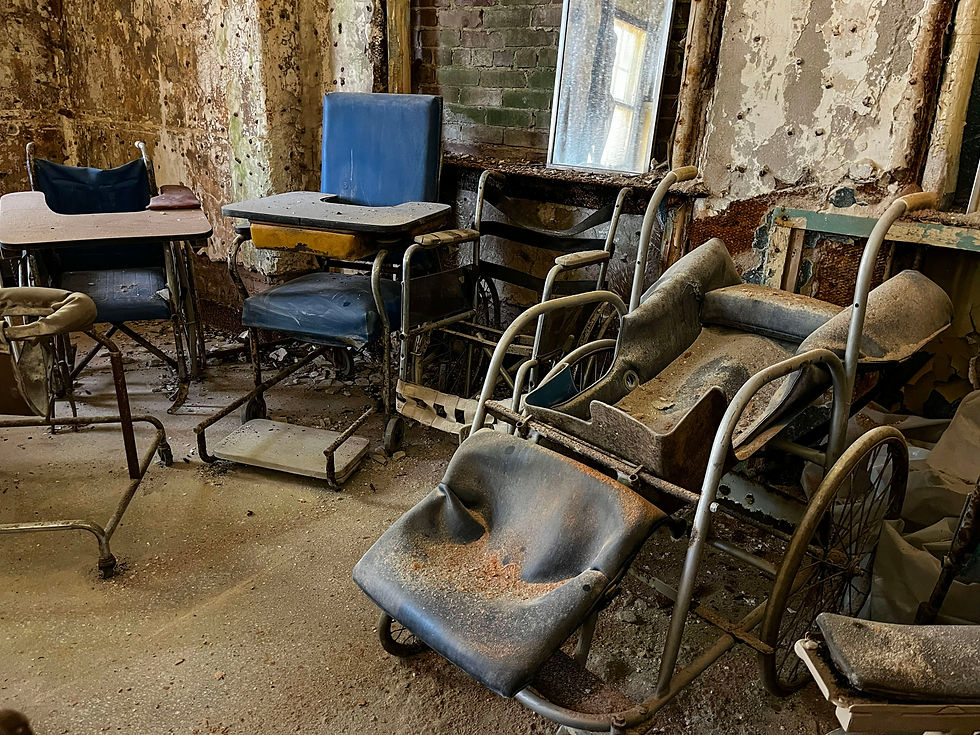
However, Pennhurst’s subsequent development brought commercial entertainment into conflict with perceptiveness and historical accuracy. In 2010, developers partially renovated the administration building as Pennhurst Asylum—a seasonal haunted attraction. Preservationists and disability advocates have sharply criticized Pennhurst’s horror-themed spectacle, arguing that it trivializes the real suffering experienced by thousands of formerly institutionalized residents. Despite these objections, Pennhurst has garnered considerable notoriety as one of America’s most active paranormal hotspots, attracting nationally-televised programs such as Ghost Finders, Syfy’s Ghost Hunters, and the Travel Channel’s Ghost Adventures, Destination Fear, and Paranormal Challenge.
Unfortunately, the name “Pennhurst Asylum” may also mislead visitors about the site’s legacy. Pennhurst was neither a psychiatric hospital nor an institution for the criminally insane. Instead, it housed people with physical and intellectual disabilities, unjustly segregated from mainstream society under the era’s prevailing social and public health doctrines. The deteriorating buildings of Pennhurst bear witness to its painful history, often obscured beneath its contemporary fictitious narrative.
Quaker Hall The Administration Building Cleaning Station Mayflower Hall Bathroom Playroom Artifact Room Tinicum Hall Courtyard Playground Patient Room Ambulance Bay Recreation
To learn more about Pennhurst's history, visit Preserve Pennhurst, Temple University, Little House of Horrors, and The Encyclopedia of Greater Philadelphia
For tour information, visit Pennhurst Asylum
Click the following link to watch the entire Suffer the Little Children television exposé


