Fort McAllister

When Confederate forces besieged Fort Sumter in April 1861, there was a miraculous sparing of human life. However, one key intangible perished amidst the destruction: the prospect of peaceful reconciliation. The impetus of war stimulated militarization efforts throughout the North and South. In Georgia, Confederate volunteers rushed to defend the state’s vulnerable coastline, with the port city of Savannah receiving particular attention. A strong fortification network was necessary to protect its shipping channels and maintain healthy economic relationships through international trade. Fort McAllister—the guardian of the Ogeechee River—was one of Savannah’s southernmost defenses.

During the summer of 1861, President Abraham Lincoln authorized the Anaconda Plan—an extensive naval blockade of Southern ports meant to exploit the Confederacy’s limited industrial capacity and discourage foreign commercial assistance. To counteract this mounting economic pressure, the Confederacy employed blockade runners—swift vessels that evaded Union patrols to transport raw materials overseas and import manufactured goods. Given its inherent risks and potential profits, blockade running quickly became a high-stakes enterprise for the Confederate war effort.
One notable blockade runner was the CSS Nashville. Launched on September 22, 1853, she gained a reputation as one of America’s fastest commercial steamships, completing her maiden voyage from New York City to Charleston in just 55 hours. After the attack on Fort Sumter, the Nashville was seized by Confederate authorities in Charleston Harbor and commissioned as the first ship in the Confederate Navy. She was outfitted with two six-pounder Blakely guns and placed under command of Lieutenant Robert B. Pegram. Throughout the latter part of 1861, the Nashville conducted several successful blockade running missions. During a voyage to Great Britain on November 19, she captured and burned the American clipper Harvey Birch in the English Channel. The Nashville continued her campaign against Union shipping, destroying another vessel, the Robert Gilfillan, on February 26, 1862. The Nashville was eventually decommissioned by the Confederate government and sold to Fraser, Trenholm and Company of England. She was rechristened the Thomas L. Wragg and remained a formidable blockade runner.
Knowing that blockade-running ships frequented Savannah, Union Rear Admiral Samuel Du Pont dispatched several squadrons to aggressively patrol the Georgia coast. On July 1, 1862, members of the USS Potomska ventured up the Ogeechee River, where they encountered the Confederate defenders of Fort McAllister. After a brief exchange of fire, the Potomska withdrew to the Ossabaw Sound.
In mid-July 1862, the Thomas L. Wragg slipped past the Federal blockade around Savannah, delivering a shipment of arms to the Confederacy. She attempted to return to Europe with a cargo of cotton, pitch, and tobacco, but had to divert up the Ogeechee River to avoid apprehension by vigilant Union vessels. Lieutenant Commodore Charles Steedman, commanding the USS Paul Jones, subsequently received orders to reconnoiter the Ogeechee River and apprehend any Confederate vessel lurking within its bends. On July 29, the Paul Jones—accompanied by commissioned gunboats Unadilla, Madgie, and Huron—engaged Fort McAllister. After several hours of futile firing, the Union fleet withdrew. Meanwhile, the Thomas L. Wragg found refuge upriver at Seven Mile Bend, where she remained moored for the next several months. While awaiting an opportunity to escape, she was refitted as an armed privateer and renamed Rattlesnake.

In January 1863, the ironclad USS Montauk arrived at Port Royal, South Carolina, commanded by Commodore John L. Worden. As a newly commissioned Passaic-class monitor outfitted with powerful fifteen-inch Dahlgren guns— the largest naval artillery pieces yet implemented during the war—the Montauk embodied the latest military innovations of the United States Navy. Union leadership sought to assess the monitor's capabilities under combat conditions, specifically its performance under concentrated fire from shoreline batteries, before launching a broader campaign against Confederate defenses around Charleston Harbor. The Ogeechee River and its sentinel, Fort McAllister, provided the perfect proving ground. Rear Admiral Du Pont instructed Commodore Worden to assault the Confederate fortress, sink the Rattlesnake, and, if successful, burn the Atlantic and Gulf Railroad bridge further upriver.
The First Battle of Fort McAllister: January 27 – March 3, 1863
“The fort was badly dilapidated, our breastworks have been blown to atoms, the guns exposed to plain
view, all port holes demolished, the barracks injured by fire, which the boys extinguished while the battle
was raging; in fact, had a cyclone struck the Fort in its full majestic force, it could not have been worse.”
— Isaac Herman, Martin’s Light Battery; February 1, 1863
On the morning of January 27, 1863, the Montauk—accompanied by the wooden gunboats Seneca, Wissahickon, and Dawn—opened fire on Fort McAllister. Heavy shells slammed into the parapets with bone-jarring regularity, displacing large quantities of sand and dirt; however, no casualties were sustained on either side. Unable to breach Fort McAllister’s defenses after five hours of sustained fire, the Union flotilla withdrew. The Confederates promptly deployed 150 enslaved laborers to repair damages and reinforce the earthworks.
The Montauk steamed back up the Ogeechee River on February 1, reinforced by the clipper C.P. Williams and her original consorts. Once again, despite their overwhelming firepower, the Union ships failed to bombard Fort McAllister into submission. However, one well-placed shell struck a rebel gunnery crew, wounding seven and killing the fort’s Scottish-born commander, Major John B. Gallie. As First Lieutenant William Dixon witnessed, “[Major Gallie] was struck by a shell on the back of the head, which tore the whole back off down to the neck leaving only the face. It was indeed a sad affair and it cast a gloom over the entire garrison, for he was much beloved by all.” Upon Major Gallie’s death, Fort McAllister’s command was relegated to 24-year-old Major George W. Anderson, Jr., the young leader of the Savannah Republican Blues—Company C of the 1st Georgia Volunteer Infantry.
In the ensuring weeks, the Union naval squadron routinely patrolled the Ossabaw Sound, determined to capture the elusive Rattlesnake. On the evening of February 27, the Rattlesnake attempted to breach the blockade, but was forced to retreat when the armored Montauk approached. The commerce raider reversed its engines and tried to maneuver backwards through the winding shipping channel, but she ran aground on a sandbar in Seven Mile Bend, just outside the protective range of Fort McAllister’s guns. This mishap left the Rattlesnake dangerously exposed, offering Federal forces a desirable target.
On the morning of February 28, the Montauk and its supporting squadron advanced up the Ogeechee River. The wooden gunships provided suppressive artillery fire against Fort McAllister, allowing the Montauk to position itself within 1,200 yards of the stranded Rattlesnake. The ironclad’s gunners opened fire, with one strategic shell striking the ship’s magazine. Within an hour, the Rattlesnake exploded in a terrific mass of flames and debris.
As the Montauk withdrew downriver, she struck a submerged river torpedo, which blew a hole in her hull. Despite the damage, the monitor remained afloat long enough for Union mechanics to beach her and perform temporary repairs. The Montauk was able to return to Port Royal for more extensive restoration.
The preliminary campaigns against Fort McAllister convinced Rear Admiral Du Pont that a single monitor lacked the necessary rate of fire to effectively neutralize the Confederate outpost. Consequently, Du Pont tasked Captain Percival Drayton to command a squadron of ironclads—the Montauk, Passaic, Patapsco, and Nahant—in a renewed attack on Fort McAllister. In conjunction, a supporting flotilla of wooden gunboats—the Wissahickon, Seneca, Dawn, Flambeau, and Sebago, along with mortar schooners C. P. Williams, Norfolk Packet, and Para—was organized to bolster the planned assault. The Federals were confident of victory. Several steamers carrying troops from the 47th New York Infantry idled in Ossabaw Sound, prepared to occupy Fort McAllister upon its anticipated capture.
The coordinated ironclad offensive commenced at 8:30 a.m. on March 3. From the outset, the Confederates demonstrated that they, too, had learned from previous engagements. Rather than wasting ammunition on the monitors’ reinforced armor, rebel gunners were instructed to conserve their ammunition and aim exclusively for the exposed gunports of the leading Union vessel. Fort McAllister’s mortar battery commander, Captain Robert Martin, even replaced gunpowder with sand in his shells, making them heavier and potentially more destructive.
The bombardment lasted over seven hours, yet Fort McAllister held firm. Around 3:30 pm, as the tides began to fall, Captain Drayton ordered his fleet to cease fire and withdraw downstream. The Union suffered no casualties, while the Confederate garrison’s only fatality was its feline mascot, Tom Cat, who appeared in the official casualty report sent to General P.G.T. Beauregard.

The attacks on Fort McAllister were meant to assess the effectiveness of Passaic-class monitors in combat. However, these engagements revealed several significant shortcomings. The monitors possessed a painfully slow rate of fire—with only two heavy guns mounted on a single revolving turret, gunnery crews could barely manage one shot every seven minutes—which limited their offensive capacity. Structural vulnerabilities also became evident. Although the monitors’ sloped iron armor deflected most direct hits, their relatively thin decks were susceptible to plunging fire from high-angle heavy mortars. Perhaps most concerning was the inferior quality of the iron fastenings securing the armor plates. In some instances, artillery strikes would knock these fittings loose, causing metal fragments to ricochet around the hull, thus endangering the crew.
With the Rattlesnake destroyed, there was little incentive to continue campaigns against Fort McAllister. The Navy Department consequently shifted its focus towards Charleston, though Rear Admiral Du Pont voiced reservations about the prospects of success. The eight guns of Fort McAllister had already posed significant challenges to the ironclads. At Charleston, Union naval forces would face several hundred guns and larger, more concentrated batteries. Drawing on hard lessons learned from the Ogeechee River, Du Pont advocated for strategic modifications before assaulting Charleston Harbor. Among his proposed revisions were strengthening the ships’ decks with additional armor and augmenting the Union fleet with more ironclads to increase their firepower.
On April 7, the revamped Federal fleet of ironclad warships—Weehawken, Passaic, Montauk, Patapsco, Nahant, Nantucket, Catskill, Keokuk, and New Ironsides—steamed into Charleston Harbor. Within minutes, the waterfront transformed into an inferno of cannon fire and smoke. The Union monitors, hampered by sluggish steering and underwater obstructions, struggled to bring their guns to bear. After two hours of heavy engagement, the Union was forced to retreat. Notably, the Keokuk took 99 hits and sank in shallow waters the next morning. The Union Navy’s abject failure at Charleston Harbor compelled Rear Admiral Samuel F. Du Pont to resign. He was succeeded by Admiral John A. Dahlgren as commander of the South Atlantic Blockading Squadron.
With operations against Fort McAllister suspended, only the USS Dawn and USS Seneca remained to blockade Ossabaw Sound. Lacking additional orders, the transports carrying the 47th New York Infantry disembarked their troops onto Ossabaw Island, where they established Fort Seymour and several bivouac sites.
The Second Battle of Fort McAllister: December 13, 1864
“The enemy’s fire redoubled in rapidity and violence; on and on we moved across the open field, and
through their netted abatis work. On and on, down into the great deep ditch and up the walls of the fort,
not a man in retreat, not a straggler in the line of blue.”
— T.W. Connelly, 70th Ohio Infantry
Following the fall of Atlanta, General William T. Sherman organized his command of 60,000 troops into two columns and commenced his March to the Sea—an attritional campaign that carved a swath of destruction through Georgia’s heartland. Lieutenant Colonel William E. Strong, General Sherman's chief of staff, recalled, "It was understood when General Sherman left Atlanta for the sea, on the 15th of November, that he would strike the coast near the city of Savannah and I think the Ogeechee River was named as the probable point.”
General Sherman recognized that effective operations against Savannah’s defenses would require a resupply effort from Admiral Dahlgren’s naval forces along the coast. The Georgian Lowcountry provided few foraging opportunities, and as provisions grew increasingly scarce, the urgency for a reliable supply line escalated. Accordingly, Sherman prioritized control of the Ogeechee River to provide an access point for Union vessels, making the capture of Fort McAllister essential to his campaign’s success.

Sherman initially directed Brigadier General Hugh J. Kilpatrick to deploy his cavalry against Fort McAllister, but Kilpatrick opposed, stating "General, I am sorry, but I don't think a regiment will take that fort." Sherman, indignant by his subordinate’s objection, exclaimed, "Why the hell don't you? There are only 250 men in the garrison." Kilpatrick replied, "Yes the garrison is not large, but I know the man commanding, and he is damn fool enough not to surrender." With that, Sherman ordered his right wing commander, Major General Oliver O. Howard, to choose an infantry division for the assault. Brigadier General William B. Hazen’s Division of the XV Corps, numbering 4,300 men, was selected for the task.
For the first time in its brief history, Fort McAllister faced an enemy advancing over land, not sea. Despite being outnumbered nearly 25-to-1, Major Anderson’s Confederate garrison prepared to fight. Under the supervision of Chief Engineer Captain Thomas S. White, the rebel encampment was relocated within the fort’s defenses. All trees within a quarter-mile radius were cut down to provide a clear field of fire. The felled timber was then utilized to construct field abatis and a defensive palisade around the fort. Additionally, the defenders buried railroad tracks rigged with torpedoes in the surrounding ground, creating yet another obstacle for the approaching Union forces.
On the morning of December 13, Hazen’s Division set out toward Fort McAllister; however, their advance was hampered by several logistical complications. Rebel saboteurs had destroyed every viable Ogeechee River crossing, forcing Union troops to traverse treacherous marshland and wade through waist-deep, brackish water. While Union engineers struggled to assemble pontoon bridges, Confederate cavalry skirmishers persistently disrupted their efforts. Despite these setbacks, Union forces managed to assemble around Fort McAllister by late afternoon. At 4:45 pm, Hazen commenced the assault. Blue-clad troops emerged from the wooded fringes at double pace. The guns of Fort McAllister answered with a thunderous barrage, raining ordnance down on the approaching Federals, yet the Union lines pressed forward. Some unfortunate soldiers stumbled onto hidden landmines, sending bodies and limbs skyward, adding to the chaos.
While the main assaulting column directly approached the fort’s ramparts, members of the 47th Ohio Infantry discovered a critical weakness in the Confederate defenses—an exposed beach landing that provided unobstructed access to the rebel earthworks. Advancing along the river bluff, these troops circumvented Fort McAllister’s heavily armed northwest bastion and breached its wooden palisades. Federal troops flooded the fort, where they clashed with Confederate defenders in fierce, hand-to-hand combat. As Union soldiers overwhelmed the fort’s interior, the remaining rebels retreated underground to continue their resistance. As Brigadier General Hazen described, “the line moved on without checking...fighting the garrison through the fort to their bombproofs, from which they still fought, and only succumbed as each man was individually overpowered.”
The Second Battle of Fort McAllister was over within fifteen minutes. Union casualties amounted to 24 killed and 110 wounded, while the Confederates suffered sixteen killed, 54 wounded, and the remaining 195 were taken prisoner. The use of buried torpedoes was a controversial defense tactic that caught General Sherman’s attention. Immediately after the battle, Sherman personally ordered the captured Confederate garrison to locate and remove all unexploded mines around the fort.
The capture of Fort McAllister provided Sherman’s army with a crucial supply line. On December 15, naval personnel cleared torpedoes and other obstructions from the Ogeechee River, enabling Union steamships to access supply depots at King’s Landing. As a result, Sherman’s troops received a much-needed influx of fresh provisions, equipment, and heavy siege artillery.

Savannah’s defenses became increasingly tenuous as Union military operations intensified around the city. Faced with the imminent threat of destruction, Lieutenant General William Hardee, who commanded Savannah’s Confederate garrison, determined that retreat was the only prudent course of action. On the evening of December 20, Hardee evacuated more than 10,000 Confederate soldiers across the Savannah River on pontoon bridges and escaped into South Carolina. As a result, on December 23, General Sherman entered Savannah unopposed, presenting the city to President Lincoln as an early Christmas gift.
Union troops occupied Fort McAllister in the weeks following its capture. However, by March 1865, the once-powerful earthen fort was completely abandoned, gradually forgotten over the ensuing decades.
In 1925, American industrialist Henry Ford purchased 75,000 acres of land along Georgia’s coast—among his acquisitions were the overgrown remnants of Fort McAllister. Concerted restoration efforts began in the mid-1930s, with preservationists working to rebuild and strengthen the fort’s earthen walls and bombproof structures. However, the project came to an abrupt halt when Ford suffered a stroke in 1945. Site ownership was transferred to the International Paper Company the following year, leaving Fort McAllister largely untouched for more than a decade. That changed in March 1958, when the Georgia Historical Commission acquired the property and resumed preservation efforts. The site officially opened as Fort McAllister State Historic Park on November 14, 1963.
Visiting Fort McAllister
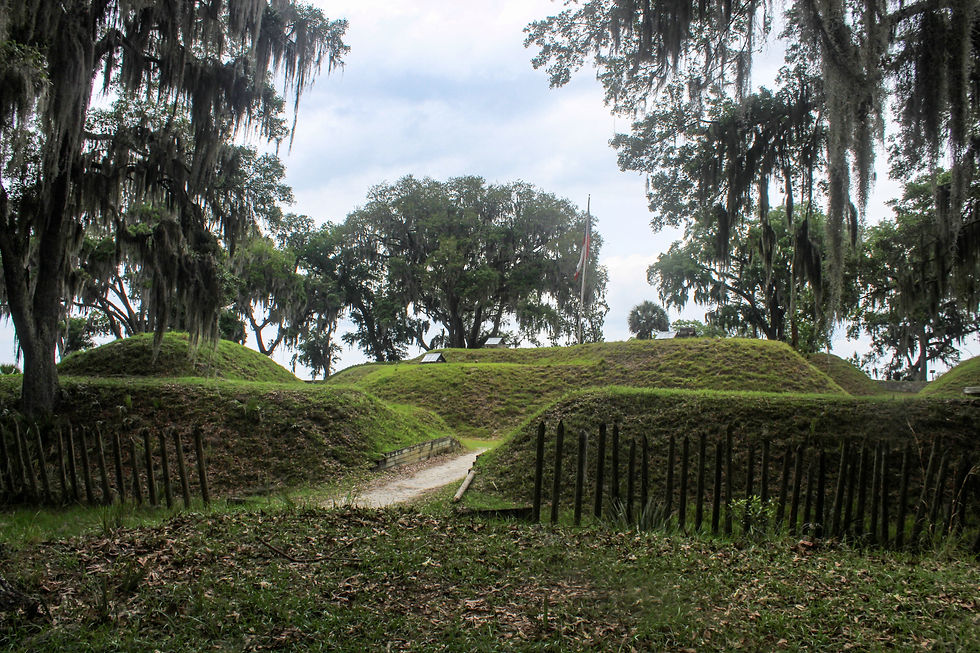
Fort McAllister State Park features an immersive museum that showcases an extensive collection of Civil War artifacts, along with arguably the best-preserved Confederate earthwork fortifications in America. Visitors have the unique opportunity to explore these impressive ramparts and discover an important chapter of Civil War history through the park’s detailed self-guided tour.
Fort McAllister is located on Genesis Point, a prominent bluff overlooking the Ogeechee River. The land was formerly owned by Colonel Joseph L. McAllister—a wealthy rice planter whose family name was given to the Confederate earthwork. Just outside the fort’s entrance stands a reconstructed signal tower, modeled after those constructed by the U.S. Signal Corps. This tower provides expansive views of the Ogeechee River and its surrounding marshlands. At its base are sites marking former Confederate encampments, including reconstructed huts that once housed non-commissioned officers.

A pedestrian bridge spans the palisade-laden dry moat, leading visitors to Fort McAllister’s sprawling parade ground and imposing earthen ramparts. Noteworthy features from the fort’s interior include the Hot Shot Furnace —a masonry structure engineered to superheat cannonballs for use against wooden vessels—and the Central Bombproof, which served as both a field hospital and supply depot throughout much of the Civil War. Today, the bombproof has been restored as an underground officers’ barracks. Along Fort McAllister’s parapet are numerous gun emplacements, each with strategic vantage points of the Ogeechee River.
Towards the rear of the site stands Fort McAllister’s east bastion, a rugged earthwork constructed under the direction of General P.G.T. Beauregard in January 1864. Equipped with light field artillery, this stronghold was strategically positioned to fend off attacks from overland forces. After exiting through the Sally Port, visitors may follow an interpretive trail across the very ground where General Hazen’s Union division mounted its dramatic frontal assault on December 13, 1864, resulting in Fort McAllister’s surrender. The self-guided tour subsequently concludes at a reconstructed Confederate mortar battery.
Fort McAllister characterizes the crossroads of military innovation, geographic strategy, and stubborn Confederate resistance. Its remarkably preserved earthworks invite visitors to contemplate the complexities of warfare along the Ogeechee River, and more broadly, the Civil War itself. Visiting Fort McAllister provides a valuable and enriching experience perfect for any American history enthusiast.
32-pounder Rifle Magazine The Parapet Reconstructed Huts Walkway into Fort McAllister Defensive Palisades Interior of Fort McAllister Park Ranger Headquarters Bombproof Hot Shot Furnace
Visit Georgia State Parks to learn more about the Fort McAllister historic site
For more Fort McAllister history, visit the American Battlefield Trust, New Georgia Encyclopedia, Vanishing Georgia, The Clio, Beyond the Yellow Brick Road Blog, Civil War Months, and DW Hike


