Fort Ticonderoga

The southern sentinel of Lake Champlain, Fort Ticonderoga occupied a strategic position at the crossroads of empires—a location that unquestionably influenced the course of North American history. Its impregnable reputation was forged from the gravitas of war, namely the 1758 Battle of Carillon, where a vastly outnumbered French garrison repelled British forces in the bloodiest conflict of the French and Indian War. This legacy of resilience resurfaced in May 1775, when American Patriots captured the fort in their first offensive victory of the Revolutionary War, galvanizing hopes for independence throughout the colonies. Today, Fort Ticonderoga remains an enduring symbol of military significance, captivating all who encounter its storied ramparts.
Ticonderoga. whose name derives from an Iroquois term meaning “the junction of two waterways,” has influenced northern New York’s history and geopolitics for millennia. Long before Europeans arrived, this strategic navigational corridor—where the La Chute River connects Lake George to Lake Champlain—enabled Indigenous peoples to conduct commercial activity and diplomacy. This site was also a contested space, specifically between the Iroquois and Algonquian nations.

The first recorded European encounter at Ticonderoga occurred in the summer of 1609, when Samuel de Champlain and two fellow Frenchmen accompanied an expedition of Algonquian allies into the area. On July 30, Champlain’s party confronted a sizable Iroquois force at Ticonderoga. During the ensuing skirmish, the Frenchmen employed their arquebus, an early firearm, which helped drive back the startled Iroquois. This episode not only shifted the dynamics of local warfare but also set the stage for enduring rivalries, as European technology and alliances reshaped the balance of power among Indigenous nations.
Throughout the seventeenth and early eighteenth centuries, Ticonderoga remained a vector for both commerce and imperial conflict. French traders from Montreal and Dutch merchants from Albany navigated these waters, exchanging furs, goods, and information between their respective colonies. Beginning in the mid-1670s, when English colonists seized former Dutch territories in New York, competition over Ticonderoga intensified, culminating in one of the most consequential conflicts of the French and Indian War.
On September 20, 1755, Philippe de Rigaud, Marquis de Vaudreuil, the Governor-General of New France, directed chief engineer Michel Chartier de Lotbinière to fortify the Ticonderoga peninsula and secure the vital waterway between Albany and Montreal. Over the next two years, construction crews gradually transformed the landscape into formidable military stronghold.
Completed in 1757, Fort Carillon stood as an impressive example of eighteenth-century military design: a rectangular structure encircled by sturdy masonry ramparts, with two triangular ravelins extending north and west to reinforce its defenses against land assaults. Bastions anchored each corner, serving as both firing positions and storage for supplies and gunpowder. Inside the walls, two-story barracks lined three sides of the parade ground. A thriving military community developed outside the fort’s walls the following year, with two hospitals, additional barracks, and several taverns and bakeries supporting daily life.
As construction progressed, French authorities intensified efforts to recruit Native allies in their fight against the British. During the summer of 1757, nearly two thousand Indigenous warriors—the largest Native American military force assembled during the eighteenth century—gathered at Fort Carillon, joining over 6,000 French soldiers and Canadian militia under General Louis Joseph, Marquis de Montcalm de Saint-Véran, the French commander-in-chief of North America.
On August 9, 1757, Montcalm’s coalition launched a coordinated attack against British Fort William Henry, situated on the southern point of Lake George. The subsequent siege resulted in a French victory, yet the aftermath was marked by an unfortunate collapse of Franco-Indigenous relations. Misunderstandings about the terms of surrender, compounded by cultural differences and grievances over the spoils of war, erupted into violence. Some Native warriors, feeling betrayed, attacked retreating British soldiers and civilians—a tragic event known as the "Fort William Henry Massacre." Contemporary accounts estimate that between 70 and 150 people were killed before French soldiers intervened and escorted survivors to Fort Edward, averting further bloodshed.
THE BATTLE OF CARILLON – JULY 8, 1758
The destruction of Fort William Henry, alongside a string of other French victories, compelled the British government to reconsider its North American strategy during the Seven Years’ War. Earlier campaigns had faltered due to divided leadership, underfunded colonial militias, and lack of coherent objectives. That all changed in June 1757, when William Pitt the Elder became Secretary of State for the Southern Department. In partnership with Prime Minister Thomas Pelham-Holles, the Duke of Newcastle, Pitt fundamentally redefined Britain’s approach to the war.
Pitt recognized that Britain’s best chance for victory lay not on European battlefields, but against French naval forces and their colonial landholdings. By undermining France’s global position, Britain could tilt the balance of power in its favor. Thus, conquering French North America became a high priority, and Pitt committed thousands of Regular troops to support this effort. Even so, he understood that provincial militias would form the bulk of British fighting forces.
For the 1758 campaign, Pitt envisioned an ambitious, three-pronged offensive designed to shatter French colonial authority in North America. General John Forbes was tasked with advancing into the Pennsylvania backcountry and seizing Fort Duquesne at the strategic Forks of the Ohio—the scene of General Edward Braddock’s infamous defeat in 1755. Simultaneously, General Jeffery Amherst would conduct an amphibious assault on Cape Breton Island, Nova Scotia, aiming to capture Fortress Louisbourg and open the Saint Lawrence River for further operations into the Canadian interior. The third major thrust, commanded by General James Abercrombie, targeted Fort Carillon and the critical Lake Champlain corridor.
General Abercrombie maintained a long service record in the British army, but despite his seniority, he lacked the vigor associated with more dynamic commanders; his promotion owed more to political connections than to battlefield prowess. Aware of these leadership limitations, Pitt appointed the energetic George Augustus, Viscount Howe, as Abercrombie’s second-in-command. At just 34 years old, Howe was among the youngest brigadier generals in the British army, admired by his troops for his competence and leadership—a reputation shared by his brothers, Richard and William Howe, who would later become prominent figures in the American Revolution.
To conquer Carillon, Abercrombie commanded what was the largest army ever assembled in North America. By June 1758, his force exceeded sixteen thousand men—about six thousand British Regulars and the remainder provincial troops provided by the colonies. This gave the British a five-to-one numerical advantage over the French defenders at Carillon.

As early as March, both Montcalm and Governor-General Vaudreuil grappled with the scale of British preparations against New France. Yet, they faced these imminent threats with little meaningful assistance from King Louis XV, who hesitated to risk large trans-Atlantic convoys given the Royal Navy’s overwhelming maritime dominance. The precarious situation was further complicated by Canada’s disastrous harvest in 1757, which led to widespread food shortages during the harsh winter.
When Montcalm arrived at Fort Carillon on June 30, he discovered a bedraggled garrison fewer than three thousand men—not nearly enough to meet the British in open battle—and less than ten days’ worth of provisions. The fort’s defenses were also in poor condition, ill-suited to withstand a protracted artillery assault. Despite these circumstances, Montcalm rushed to strengthen Carillon's outer defenses. French troops began constructing extensive earthworks, log breastworks, and abatis—an entanglement of sharpened branches designed to slow enemy infantry—approximately three-quarters of a mile northwest from the fort. Montcalm also sent word back to Montreal, urgently requesting reinforcements from the Chevalier de Lévis and his four hundred men.
On July 5, Abercrombie’s army left the ruins of Fort William Henry, filling Lake George with hundreds of small boats and landing unopposed on the north shore the next morning. By midday, the troops had all disembarked, though their artillery remained on rafts. As the main force advanced along the west bank of La Chute, dense woods quickly disrupted their formations. Abercrombie later recalled: “The wood being thick, impassable with any Regularity to such a Body of Men, and the Guides unskilled, the Troops were bewildered, and the columns broke, falling in on one another.”
Near Trout Brook, an unexpected skirmish erupted between Captain Louis-Joachim de Trépezec’s squadron and General Phineas Lyman’s Connecticut regiment. The British initially withdrew, wary of a larger French force, but provincial militia soon flanked Trépezec’s men and routed them with a deadly enfilading fire. About 150 French soldiers, including Trépezec himself, were killed, and another 150 taken prisoner. British losses totaled 87 killed and more than twice as many wounded. Among the dead was General George Howe, killed while restoring order at the front—a catastrophic loss for British command. Howe had been the architect behind the campaign’s logistics and tactical planning. Brigadier General Thomas Gage was promoted to second-in-command, but neither Abercrombie nor his officers could fill the void left by Howe’s death. The army’s morale consequently suffered. As one soldier observed, “the soul of General Abercrombie’s army seemed to expire … neither order nor discipline was observed, and a strange kind of infatuation usurped the place of resolution.”
Following the brief but costly engagement at Trout Brook, Abercrombie regrouped his men at the Lake George landing. Two days passed before he made any attempt to reconnoiter the French lines. While Abercrombie frittered away his numerical advantage, Montcalm’s army worked tirelessly to complete their earthen defenses.
On July 7, Abercrombie received reports from scouts and prisoners that Montcalm had approximately six thousand men and was expecting Chevalier de Lévis to arrive soon with an additional three thousand reinforcements. Facing the prospect of a larger-than-anticipated enemy force, Abercrombie ordered Lieutenant Matthew Clark, a young military engineer, to ascend Mount Defiance and assess the French position. Although Lieutenant Colonel William Eyre, an experienced engineer, was available for this assignment, Abercrombie rejected his expertise following an earlier dispute over regimental command.
From his vantage point atop Mount Defiance, Clark reassured his superior that the French fortifications appeared unfinished and could be “easily forced, even without cannon.” This impression was exactly what Montcalm intended; the French had carefully camouflaged their breastworks with fir boughs and brush, making them appear as a rudimentary trenchwork when viewed from above.
Emboldened by faulty intelligence and anxious to attack before French reinforcements arrived, Abercrombie imprudently decided to launch an all-out infantry assault the next day without bringing up any of his artillery for support. In doing so, Abercrombie ignored several viable alternatives, such as outflanking the French breastworks, employing his artillery, or laying siege to the fort.

Early on July 8, British forces moved toward Fort Carillon with false confidence. Major Robert Rogers and his renowned colonial Rangers led a vanguard of nearly 2,500 men, tasked with engaging the enemy while General Gage’s main body prepared to assault the heights of Carillon.
As the wooded landscape transitioned into tree stumps and tall grass, Rogers’s men were suddenly ambushed by two hundred French soldiers. Rogers quickly formed a battle line and pressed on, only to discover heavily fortified French lines with deep entrenchments and abatis—not the flimsy earthworks previously reported by Lieutenant Clark.
Around midday, several New York regiments began engaging Montcalm’s right flank. Confusion and impatience spread through the British ranks as the woods echoed with intense gunfire. Without Abercrombie at the front, real-time tactical decisions fell to subordinates like Colonel William Haviland, who commanded the right flank. Contrary to Abercrombie’s explicit orders to wait until the entire army was formed, Haviland sent Rogers’s men forward to the abatis and provide covering fire for a general advance. This premature assault shattered any prospect of a coordinated attack, and Abercrombie’s plan quickly unraveled.
British soldiers fixed bayonets and pushed into the abatis—the lines disrupted by sharpened branches. While fighting through the thickets, a distant French voice rose above the din, and gun smoke erupted along the length of the breastworks. The French, arranged three deep behind their defenses, had placed their best marksmen at the keyholes; the men behind them loading weapons to maintain a relentless rate of fire. The air filled with bullets, and British soldiers fell haplessly against the withering volleys. Trapped within the abatis, many front-rank soldiers were driven into the wooden spikes as those behind pressed desperately for cover.
When news of this initial failure reached Abercrombie at his headquarters, he grew angry and stubbornly insisted that the attacks continue against the unbroken French position. His order reverberated through the forest, and again, the battered British lines moved toward the resolute French defenses.
Abercrombie did make a dawdling attempt to deploy his artillery, but the effort was poorly executed. The British artillery barges lumbered up Lake Champlain, unwieldy and exposed beneath the guns of Fort Carillon. Once within range, French gunners opened fire, quickly shattering the flotilla’s formation. Several boats were sunk and the remainder retreated.
Over the next four hours, British forces battered themselves headlong against the French position with appalling losses, each regimental commander acting independently in a series of uncoordinated frontal attacks.
Around 5 pm, the 42nd Scottish Highlanders—the Black Watch—mounted a final, desperate charge that briefly breached the French defenses; however, those who managed to scale the earthworks were met with bayonets. The Highlanders’ heroism became legendary, but their sacrifice was immense. Of the 1,100 Highlanders engaged, 647 were killed or wounded—a staggering 65 percent casualty rate, the highest suffered by any British regiment during the war.

When Abercrombie learned the outcome of the final assault, he recognized the futility of further attacks and ordered a general retreat. The withdrawal soon devolved into disorder, exposing a breakdown of effective command. A more perceptive leader might have regrouped at the Lake George, reassessed the situation, and prepared for siege operations. Instead, Abercrombie led his forces all the way back to Fort William Henry, amplifying the sense of defeat and humiliation within the British ranks. Abercrombie never led another military campaign and was recalled back to England in September 1758. As one of his former medical officers observed, “The General returns to Europe as little regretted as any man that ever left America. He had no resolution, no will of his own, was bullied into the favours he bestowed, made few friends thereby, created some enemies, and in short fell into universal contempt.”
Against overwhelming odds, Montcalm’s garrison delivered a decisive and costly defeat on the British. Abercrombie’s losses totaled 551 killed, 1,356 wounded, and 77 missing, while the French sustained 104 killed and 273 wounded. Together, these casualties made the Battle of Carillon the bloodiest single-day engagement in North America prior to the Mexican-American War. In its aftermath, Fort Ticonderoga became mythologized as a symbol of impregnability and martial prowess.
Despite Abercrombie’s abject failure at Carillon, the British secured key victories at Fort Duquesne and Louisbourg. These successes exposed French settlements along the Saint Lawrence River, making them vulnerable to attack. During the summer of 1759, British forces besieged Quebec. All available French units were recalled to defend the city, leaving outposts like Fort Carillon dangerously undermanned.
On July 27, 1759, eleven thousand troops under British General Jeffery Amherst approached Fort Carillon and its token force of four hundred French defenders. Facing overwhelming odds, the outnumbered French garrison abandoned the fort, igniting the powder magazine as they withdrew. The resulting explosion devastated the Southeast Bastion and East Barracks, though the main fortifications remained largely intact. British provincial troops quickly repaired the surviving structures, although the East Barracks and powder magazine were never rebuilt. Finally in British hands, Fort Carillon was renamed Fort Ticonderoga.
A REVOLUTIONARY TRIUMPH
By 1775, Fort Ticonderoga was in “ruinous condition;” a neglected outpost crumbling on the American frontier. The British maintained only a small garrison there—48 men from the 26th Regiment of Foot, many of whom were "invalids" assigned to limited field duties. Despite its dilapidated state, the fort’s strategic value within the Champlain Valley endured, and its stockpile of heavy artillery promised a decisive advantage during the Revolutionary War’s opening phase.
Following the outbreak of hostilities at Lexington and Concord, Patriot militias encircled the British army in Boston. Yet, despite their numerical advantage, American forces lacked the necessary artillery capacity to maintain an effective siege. This shortage set the stage for a bold solution.
Benedict Arnold, then Captain of the Governor’s Foot Guard—a respected Connecticut militia unit—recalled seeing Ticonderoga’s substantial, yet vulnerable weapons cache. Recognizing an impassible opportunity to advance his own military ambitions and the larger Patriot effort, Arnold traveled to Boston and presented his plan to capture the fort’s arsenal before the Massachusetts Committee of Safety. Although the Committee initially expressed reservations, Arnold ultimately received a colonel’s commission and official authorization to lead this “secret service” on May 3, 1775.
Arnold raised recruits throughout western Massachusetts. But when he reached Stockbridge on May 6, Arnold was surprised to learn that another independent expedition against Fort Ticonderoga was already underway. The Connecticut Colony had organized its own campaign under the leadership of Ethan Allen, the charismatic commander of the Green Mountain Boys—a militia formed to protect land claims in the New Hampshire Grants, present-day Vermont.
Arnold pressed on to Castleton, Vermont, where he found Allen awaiting reinforcements. The two officers convened a council of war to determine who would lead the expedition. Arnold claimed command, presenting his official orders from the Massachusetts Committee of Safety. However, many of the Green Mountain Boys rejected Arnold's authority and threatened to disband without Allen as their leader. After fraught negotiations, Allen and Arnold agreed to a joint command. Their combined force ultimately consisted of approximately one hundred Green Mountain Boys, joined by sixty volunteers from Connecticut and Massachusetts.

On the evening of May 9, Allen and Arnold assembled their men on the eastern shore of Lake Champlain, intending to cross under cover of darkness. Delays arose due to a shortage of boats, but despite these setbacks, Allen, Arnold, and 83 Green Mountain Boys managed to complete the initial crossing. With dawn fast approaching, Allen and Arnold recognized the urgency of the moment. Instead of waiting for their remaining men, they decided to attack immediately with their available troops.
Just before sunrise on May 10, 1775, American forces easily overran Fort Ticonderoga and its unsuspecting British garrison. When Captain William Delaplace, the fort’s commander, demanded to know under whose authority the Americans acted, Allen allegedly exclaimed, “In the name of the Great Jehovah and the Continental Congress!” The British surrendered without resistance, securing the Americans their first offensive victory of the Revolution. The capture of Fort Ticonderoga also proved materially significant, as the fort’s entire complement of ordnance fell into Patriot hands. Among the spoils were one hundred cannons, a 13-inch siege mortar, and numerous swivel guns.
After the victory, discipline among Allen's men quickly eroded. They plundered the premises for liquor and other provisions, toasting Congress and the “liberty and freedom of America.” Captain Delaplace protested when his private liquor stash was confiscated, but Allen dismissed his complaints, offering only a perfunctory receipt in return.
Arnold was equally disgusted by this shameful lack of military discipline. He noted that the Green Mountain Boys “[committed] every enormity”—destroying personal property, behaving rudely, and neglecting their military duties. Within a matter of hours, the American operation had degenerated to “the greatest confusion and anarchy.”
When the liquor supplies dwindled, Allen and his men departed, leaving Arnold in charge of Fort Ticonderoga. He remained until General Benjamin Hinman arrived to relieve his command later that June. Another dispute over authority soon erupted, as Arnold’s instructions from the Massachusetts Committee did not direct him to serve under Hinman. Feeling slighted, Arnold resigned his commission and returned home, having spent over £1,000 of his own money on the campaign. This episode marked the beginning of Arnold’s contentious relationship with Congress and the Continental Army.
In July 1775, Major General Philip Schuyler used Fort Ticonderoga as a staging ground for the American invasion of Quebec. While coordinating the northward advance, Schuyler fell seriously ill and returned to Ticonderoga, where he directed logistical operations for the ongoing campaign.
Meanwhile, Fort Ticonderoga’s arsenal drew the attention of another rising Continental officer: Henry Knox. While Benedict Arnold had originally proposed moving the fort’s artillery to Boston, it was Knox—a self-taught artillerist—who persuaded General George Washington to pursue the plan in late 1775.
On December 5, Knox reached Lake Champlain and selected 59 pieces of heavy ordnance from Fort Ticonderoga and nearby Crown Point. He and his men then embarked on the “Noble Train of Artillery,” transporting the cannon over three hundred miles to Boston. Their route crossed frozen rivers, snow-covered mountain passes, and exposed them to harsh winter conditions, making the journey one of the most remarkable feats of the Revolutionary War.
Knox arrived in Cambridge, Massachusetts, on January 25, 1776, astonishing both Washington and the Continental Army. On the night of March 4, Washington positioned Knox’s guns on Dorchester Heights, which provided a commanding vantage point over British-occupied Boston. The renewed threat of bombardment rendered the British position untenable, compelling them to evacuate the city on March 17, 1776.

After the ambitious American invasion of Canada collapsed in May 1776, the demoralized and disease-ridden Continental Army retreated to Fort Ticonderoga, where General Horatio Gates assumed command. Under Gates’s leadership, the army began strengthening the peninsula’s defenses, focusing on both land and naval fortifications along the Lake Champlain corridor.
Fort Ticonderoga itself was positioned on a southern promontory, which left it exposed to northern attacks. Aware of this vulnerability, Gates ordered the fortification of Rattlesnake Hill—later christened Mount Independence—directly across the lake. This new defensive anchor featured shoreline trenches, a horseshoe-shaped artillery battery, a summit citadel, and redoubts encircling the crest. To ensure efficient communication and movement between Ticonderoga and Mount Independence, a quarter-mile floating bridge was also constructed across the lake.
Despite these preparations, Sugar Loaf Hill (now Mount Defiance)—which overlooked both American strongholds—remained unfortified. Adjutant General John Trumbull had highlighted this risk, but the prevailing wisdom held that dragging cannon up its steep slopes was impossible. Thus, the hill was left undefended.
Both British and American commanders understood that maintaining naval supremacy on Lake Champlain was essential for securing the northern approach to the Hudson River Valley. Throughout 1776, both sides raced to augment their fleets. Benedict Arnold oversaw the construction of an American squadron at Skenesborough (now Whitehall, New York) before bringing the vessels to Ticonderoga for completion.
On October 11, 1776, the British fleet under Guy Carleton confronted Arnold’s American flotilla at the Battle of Valcour Island. Though outgunned and outnumbered, Arnold’s forces fought doggedly for four hours before attempting a daring nighttime escape. While most of the American ships were lost in the ensuing pursuit, the confrontation significantly delayed the British advance. Even though lead British units came within three miles of Ticonderoga, the approaching winter season compelled Carleton to withdraw to Quebec. The action at Valcour Island, though a tactical defeat, bought the Continental Army valuable time to shore up defenses along the northern frontier.
Following Carleton’s retreat, the American army also withdrew for the winter. General Gates departed for Philadelphia, leaving Colonel Anthony Wayne in command of the depleted and poorly supplied garrison at Ticonderoga, numbering scarcely three thousand men.
THE SIEGE OF FORT TICONDEROGA: JULY 2 – 6, 1777
“Where a goat can go, a man can go. And where a man can go, he can drag a gun.”
– British Major General William Phillips
In March 1777, Continental leadership anticipated a British campaign targeting the Hudson River corridor. General Schuyler requested ten thousand troops to secure Fort Ticonderoga and another two thousand to defend the Mohawk River Valley. General Washington, who had never personally visited Ticonderoga, doubted the likelihood of a British overland attack from the north because of the fort’s perceived impregnability. Consequently, no significant reinforcements or fortification efforts were made at Ticonderoga. Later that April, Brigadier General Anthony Wayne departed Ticonderoga to join Washington’s main army, leaving General Arthur St. Clair in command of approximately two thousand men—an insufficient force to defend the area’s extensive fortifications.
Meanwhile, British General John Burgoyne devised an ambitious strategy to isolate New England and quell the American Revolution. His plan involved a coordinated, two-pronged offensive: General William Howe advancing north from New York City and Burgoyne descending from Canada. The two armies intended to converge in Albany, where their combined strength would decisively defeat Washington’s Continental Army in battle.
Burgoyne’s army, nearly 8,000 strong—composed of British regulars, Hessian auxiliaries, Loyalists, and Native American allies—commenced its southward campaign in mid-June. The first significant obstacle was Fort Ticonderoga, guarding the southern end of Lake Champlain.

Expecting a difficult siege, Burgoyne divided his forces. Brigadier General Simon Fraser's advance guard maneuvered west of Lake Champlain to outflank the American defenses on Mount Hope, while Baron Friedrich Adolf Riedesel’s Hessians targeted Mount Independence to the east. Burgoyne also ordered his men to occupy Mount Defiance—a position previously considered inaccessible—and install field artillery.
By July 2, Fraser had captured Mount Hope’s outer defenses, and within days, British cannon were placed atop Mount Defiance. The sudden and ominous appearance of British ordnance overlooking the fort shocked the American defenders, who realized that Ticonderoga could not withstand a sustained bombardment. In a conversation with one of his quartermasters, St. Clair solemnly remarked that he could either "save his character and lose the army" by holding the fort, or "save the army and lose his character" by retreating.
After conferring with his officers, St. Clair chose to abandon Ticonderoga. Under cover of darkness on July 5, 1777, the garrison evacuated supplies, wounded, and noncombatants by boat, while the main force retreated toward Mount Independence. Burgoyne’s troops entered the fort without resistance the next day.
The uncontested surrender of Ticonderoga outraged the American public and military leadership. Both St. Clair and Schuyler faced harsh criticism from Congress and were relieved of their commands. Although a subsequent court martial in September 1778 fully exonerated both men of any wrongdoing, their reputations suffered, and neither returned to active field duty.
As Burgoyne continued his campaign south, Fort Ticonderoga became a base for British logistics and communication—Brigadier General Henry Watson Powell guarded the post with seven hundred soldiers. In September 1777, General Washington dispatched Major General Benjamin Lincoln to disrupt British operations in the Champlain Valley. Seeking to break Burgoyne’s supply lines and liberate American prisoners-of-war, Lincoln ordered a daring raid on Fort Ticonderoga.
On September 18, Colonel John Brown led a contingent of five hundred men against Ticonderoga’s defenses. Brown first surprised a British detachment near the Lake George landing, while another group scaled Mount Defiance and captured a sleeping construction crew. The British garrison at Ticonderoga remained unaware of the American presence until Brown’s men engaged the defenders occupying the old French lines. Once discovered, the Americans opened fire with artillery, prompting a vigorous response from nearby British ships. This strong resistance deterred Brown from attempting a direct assault on the well-fortified position.
A stalemate persisted for several days. On September 21, one hundred Hessian reinforcements arrived from the Mohawk Valley, bolstering the British defenses. Brown attempted to negotiate by sending a truce party to the fort, but British soldiers fired upon them, killing three of the five envoys. Facing increasing resistance and recognizing the futility of continued attacks, Brown ordered a withdrawal on September 22. Although the raid failed to reduce Fort Ticonderoga, Brown’s men managed to free 118 American prisoners and capture 293 British troops, all while suffering fewer than ten casualties during the operation.

Following Burgoyne’s surrender at Saratoga in October 1777, British forces torched Ticonderoga and retreated northward. Although American colonists regained control of the fort, it was never re-garrisoned. Ticonderoga became increasingly irrelevant after Saratoga, as the focus of military operations shifted south. The fort functioned primarily as a waypoint for sporadic British and Loyalist raids along the New York–Canada frontier.
Fort Ticonderoga fell into abandonment after the Revolutionary War. Local residents salvaged building materials from the site, sometimes even melting down cannons for metal. By the end of the eighteenth century, the fort had fallen into decay; its stone barracks gutted and timber structures dismantled.
The ruins of Fort Ticonderoga soon drew attention for their historical significance and picturesque setting. George Washington himself visited in 1783, and artists such as Thomas Cole found inspiration here—Cole’s earliest signed work, Gelyna: A View from Ticonderoga, captures the site’s romantic atmosphere.
In 1802, the State of New York transferred the fort’s property to Columbia University and Union College as a joint trust. After the War of 1812, increasing settlement along Lake Champlain’s western shore encouraged the colleges to sell their land endowment. In 1820, New York City merchant William Ferris Pell purchased 546 acres around the old fort. He started preservation work on the site later that year—the first such effort for a historic battlefield in American history. In 1826, Pell constructed the Pavilion—a summer house near the fort ruins—which soon became a hotel for tourists drawn by the site’s historic and scenic allure.
Restoration of Fort Ticonderoga to its presumed eighteenth-century appearance began in 1908, led by English architect Alfred Bossom and Stephen Hyatt Pell, with financial support from Pell’s father-in-law, Robert M. Thompson. The Fort Ticonderoga Museum opened to the public on July 6, 1909, with President William Howard Taft presiding at its dedication. In 1931, Stephen Pell established the Fort Ticonderoga Association, which continues to manage the historic site today.
VISITING FORT TICONDEROGA
Fort Ticonderoga’s landscape features several historic sites, including the reconstructed masonry fort, Carillon Battlefield, Pell Pavilion, King’s Garden, and Mount Defiance. Each location interprets distinct chapters in Ticonderoga’s history, spanning from Indigenous settlement and colonial warfare to the advent of early American tourism and historic preservation. Fort Ticonderoga itself offers visitors a variety of programs—such as guided tours, educational demonstrations, and living history exhibits—that illuminate the lives of soldiers, civilians, and Native Americans connected to Ticonderoga’s past. For those interested in a deeper, more cultivated experience, specialized itineraries and premium tours are available for an additional fee.
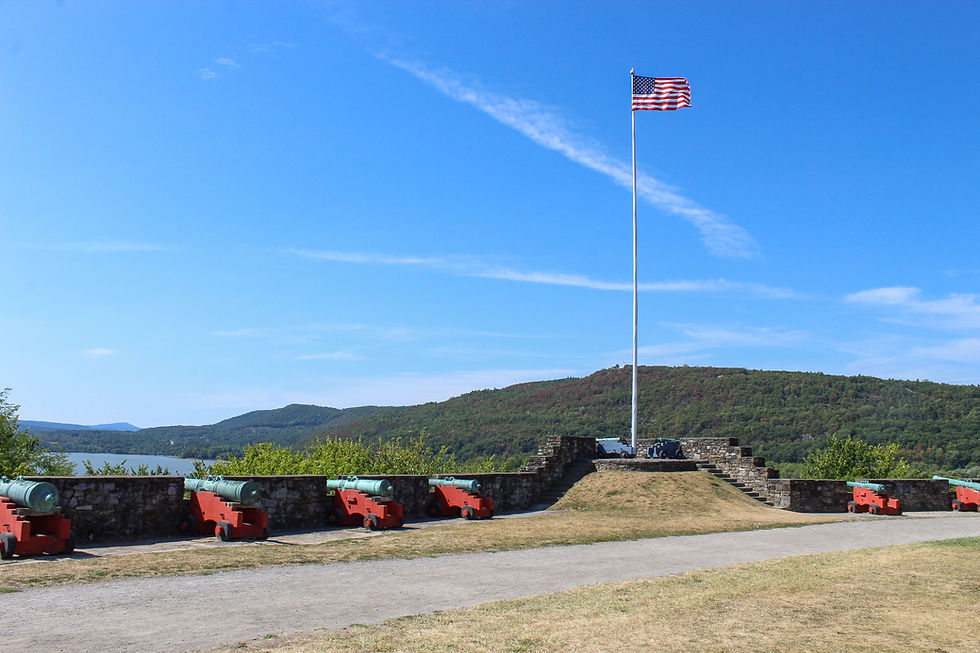
The fort’s stone ramparts and bastions bristle with artillery and capture dramatic views of Lake Champlain. Inside, three interpretive buildings surround the Parade Grounds. The Mars Education Center, located furthest to the right, features several fascinating exhibits and thousands of artifacts—many recovered through archaeological excavations—that trace the site’s development from early colonization through the Revolutionary War. Situated around the sally port, the Soldiers’ Barracks contain detailed displays about the fort’s construction, eighteenth-century weaponry, military medicine, material culture, and Ticonderoga’s broader legacy. The Officers’ Barracks round out the ensemble; its rooms reflect living arrangements typical during French and British occupation.

Once visitors complete their tour of Fort Ticonderoga, they may follow the walking path down to the King’s Garden and Pavilion. These fertile lowlands were originally cultivated by Ticonderoga’s garrison to supplement their limited winter rations. When William Ferris Pell acquired the property, he planted an extensive arboretum and leased the land to tenant farmers. During the fort’s reconstruction, the Pell family hired Marian Cruger Coffin—an MIT graduate and one the nation’s first practicing female landscape architects—to construct the ornamental King’s Garden. Coffin’s vision transformed the utilitarian garrison plots into a six-acre showpiece of American landscape composition, blending formal European influences with native Adirondack plant species. Her design included thousands of annuals and perennials, lush borders, rustic brick walls and walkways, sculptural accents, and a striking Lord & Burnham greenhouse.
Adjacent to the King’s Garden stands the Pavilion—a magnificent Greek Revival structure built between 1826 and 1837. Originally William Pell’s private residence, the Pavilion later became a hotel to accommodate the thousands of visitors eager to explore Fort Ticonderoga’s storied ruins. The hotel closed around 1900, but remained the Pell family’s summer retreat until 1987. Today, the Pavilion is only accessible through a premium tour that details the Pell Family, Ticonderoga tourism, and ongoing preservation efforts.
Located just east of Fort Ticonderoga, the Carillon Battlefield Hiking Trail traces a 1.75-mile loop around one of North America’s bloodiest landscapes. Beginning at the Visitor Center, the path crosses the Historic Military Encampment Field, where Montcalm’s French Army encamped during the summers between 1756 and 1759. When British forces captured Fort Carillon in July 1759, General Amherst’s men took control of these same fields. Later, Americans left their own mark, specifically a garrison cemetery that inters the remains of several hundred soldiers.
Entering the woods, hikers can spot subtle terrain changes that reveal layers of the region’s history. The first shallow depressions belong to nineteenth-century farm buildings, as Ticonderoga’s landscape was regularly cultivated through the 1870s. The next series of depressions likely indicate a Revolutionary War-era hut, possibly built by Pennsylvania soldiers during the fall of 1776. Deeper within the thickets, visitors encounter the remains of a British siege battery from around 1759, followed by a line of French breastworks constructed before the Battle of Carillon.
The trail then follows Sandy Redoubt Road, passing the area where General Abercrombie’s British troops launched their ill-fated assault against Fort Carillon. Further east stands the “Great Redoubt”—the approximate center of the British attack—some of the best-preserved earthworks from the French and Indian War. Across the Carillon Battlefield, several markers commemorate key moments and regiments, including a memorial for the Black Watch and a replica of Montcalm’s Cross. The original cross, erected behind the French breastworks on August 21, 1758, bore the following inscription: “Christian! It was not Montcalm and his prudence. Nor these felled trees, the heroes, their exploits, which dashed the hopes of the bewildered English. It was the hand of thy God, conqueror on this cross.” The battlefield trail concludes approximately a half-mile from this point.

The final destination within Fort Ticonderoga’s property is Mount Defiance, about a fifteen-minute drive from the main fortification. Visitors who make the ascent up the steep mountain road are rewarded with commanding views of Lake Champlain, the distant Green Mountains, and Fort Ticonderoga below. It was here, in July 1777, where General Burgoyne’s British artillerists installed two twelve-pounder cannons, surprising Ticonderoga’s American garrison and hastening their decision to abandon the fort. Later that September, Colonel John Brown’s regiment briefly recaptured this overlook, only to withdraw a few days later.
The significance of Fort Ticonderoga extends far beyond its stone ramparts. More than an eighteenth-century military installation, it represents unwavering resolve, the folly of assumption, and the enduring hope of self-determination. The events that unfolded at Ticonderoga still echo across the Champlain Valley, shaping the broader narrative of American independence.
King's Garden and Pavilion West Inner Rampart Outer Rampart Artillery American Redoubt (c. 1777) The Black Watch Memorial American Redoubt (c. 1777) Cupid Statue Artillery The Great Redoubt Parade Ground and Barracks British Carillon Monument Boat Launch at Lake Champlain North Ravelin Artillery Black Watch Monument The Great Redoubt Heritage Breed Cows The Garage (c. 1915) Discovery Garden American Garrison Cemetery Greenhouse View of Ticonderoga Sally Port Garrison Plot King's Garden Mars Education Center Lake Champlain North Ravelin French Breastworks Mortars on the West Ravelin Montcalm Monument Mars Education Center Interior Wall Cannon Atop Mount Defiance Officers' Barracks Outer Walls Officers' Barracks View from the North Ravelin Gangway to North Ravelin South End of Lake Champlain Soldiers' Barracks Barracks Powder Magazine Pell Family Cemetery Parade Ground North Ravelin Y-D House (c. 1912)
Check out Fort Ticonderoga to plan a visit, view upcoming events, and browse current exhibits and collections
For more Fort Ticonderoga history, visit the American Battlefield Trust, the University of Vermont Consulting Archaeology Program, Legends of America, and the Boston Society of Civil Engineers Section
To learn more about the Battle of Carillon, check out the American Battlefield Trust, American Heritage, Warfare History Network, Crossroads of a Continent, Emerging Revolutionary War, and War History Online
Visit the American Battlefield Trust, Warfare History Network, American History Central, and History is for Everyone for more information about the May 1775 Capture of Fort Ticonderoga
For more about the 1777 Siege of Fort Ticonderoga, visit the American Battlefield Trust, British Battles, ArcGIS, Americana Corner, and ThoughtCo


